
If your dog or cat had an accident on the carpet months ago — and you thought you'd dealt with it — the last couple of weeks may have proved you wrong. We've had far more calls about pet odour in the past week than we'd normally get in a month, and it isn't because more pets are having accidents. It's the heat and humidity.
The smell isn't new. The weather woke it up.
Urine doesn't stay wet in a carpet for long, but it doesn't disappear either. It dries down into uric acid crystals, bound into the carpet backing and, if enough went down, the underlay beneath. Dry and cool, those crystals are largely dormant — which is exactly why a patch can seem to have "gone" for weeks or months.
Heat and humidity change that. Warmth reactivates the crystals and speeds up the bacteria that produce the odour in the first place, so a patch that was sitting quietly comes back to life — often more strongly than it smelled the first time. It's the same reason a car interior or a bin smells worse on a hot day. Nothing new happened. The conditions just made the old contamination active again.
This is exactly the pattern we hear on the phone: "it was fine, then all of a sudden this week…" It usually wasn't fine. It was just cool enough not to notice.
Why you can't just clean it again yourself
The natural instinct is to hit the patch with a carpet spray or hire a rental machine. Both run into the same problem: they treat the surface, not the contamination sitting in the backing and underlay. Worse, rental machines and supermarket carpet treatments can wash it deeper into the carpet, underlay and subfloor more than they extract back up. A patch that was contained in the carpet fibres can end up saturating the underlay and even the floor beneath that, which makes the problem harder to fully resolve, not easier.
If you've already tried a rental machine or a shop-bought product and the smell has come back anyway, that's not a sign you did it wrong — they weren't designed for deep cleaning and contamination extraction.
How we actually deal with it
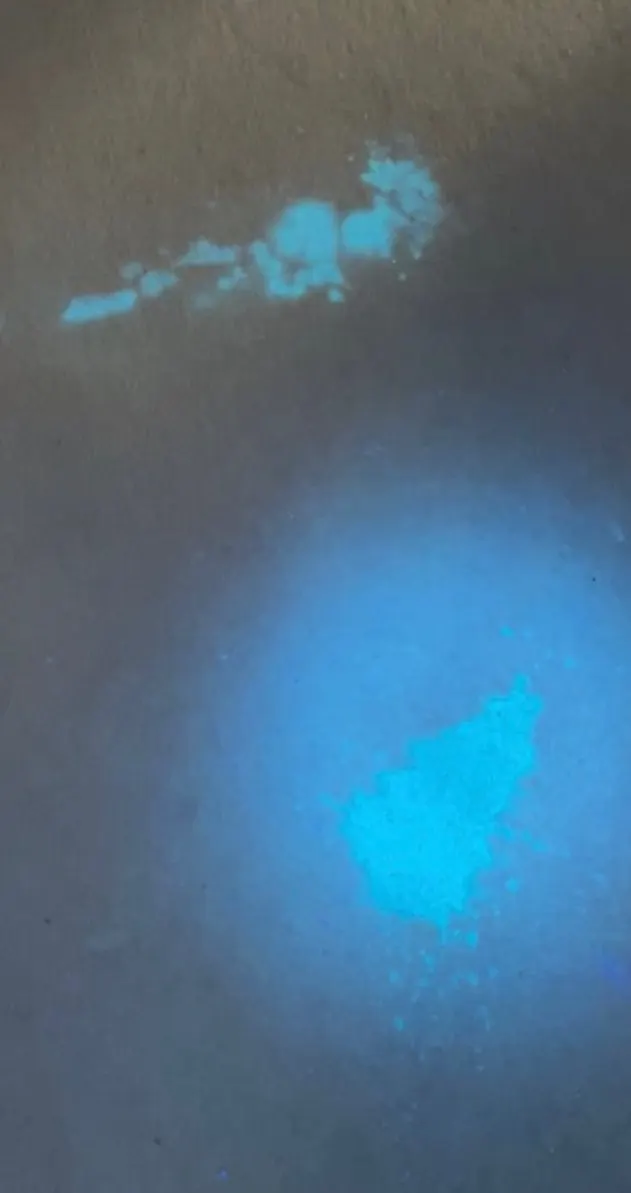
We sweep the affected area with a high-powered UV torch first. Urine fluoresces under UV, so every patch shows up clearly — including the ones you can't see, smell, or feel through the carpet. That matters more than people expect: where there's one patch you noticed, there are very often several more you didn't.
- UV-light sweep across the affected area — every patch found before we start, not discovered halfway through.
- Up to 1 litre of professional urine neutraliser, free — used at the strength the situation needs; for heavier contamination we'll mix it at double concentration.
- Individual patch treatment with sub-surface extraction — a handheld tool built specifically to treat and extract at the point of contamination, not just the surface.
- Full carpet clean over the top — so it's clean as well as odour-free, not just odour-free.
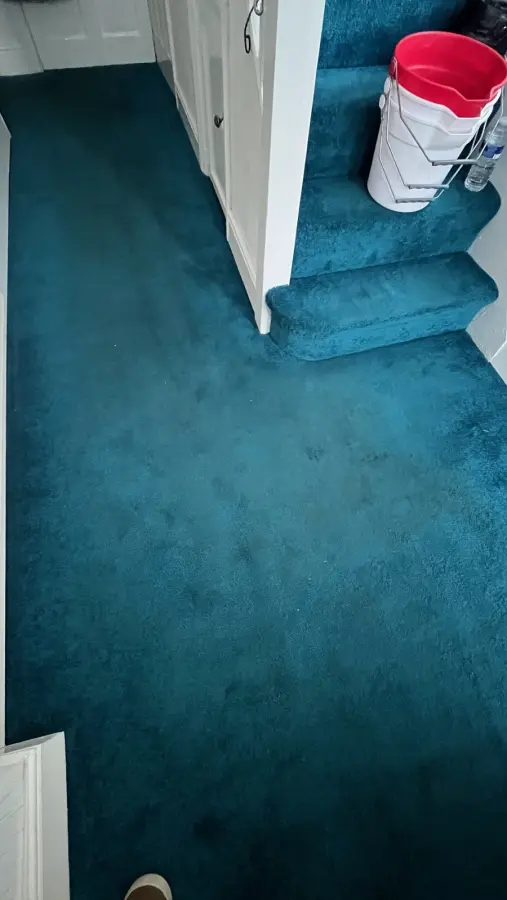
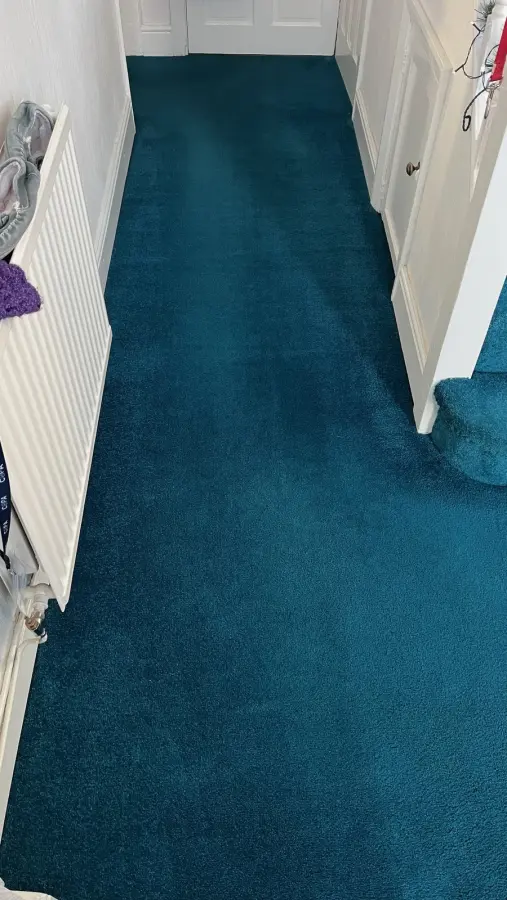
Heavy urine contamination, months of buildup, on a teal carpet. UV-found patches, individual neutralisation, full clean over the top. Real job, no edits.
A recent example
One job that sums this up well: a family with two house-trained sausage dogs, both small. The UV sweep showed dribble patches all the way up the right-hand side of the stairs — almost certainly the dogs leaking small amounts as they went up, low to the ground, banging their bellies against each step, building up over time. There was a faint odour but none of it was visible until we used our high-powered UV torch. One litre of neutraliser, treated patch by patch, and it was gone — no smell, no staining.
What we're honest about
Most pet contamination is fully recoverable at carpet level. Some isn't. If urine has soaked through to the underlay — and especially the subfloor — full neutralisation from the top down isn't always possible, because the contamination is held in the structure of the floor, not the carpet itself. If that's the situation, we'll tell you honestly before we start what we think is achievable, rather than promise something we can't deliver. As with any deep odour work, we don't give guarantees — only a straight assessment before we begin.
If the smell's come back this week, it's worth sorting properly.
A UV sweep is included on every clean we do — not just dedicated pet jobs. Get in touch and we'll talk through what we think we can achieve.